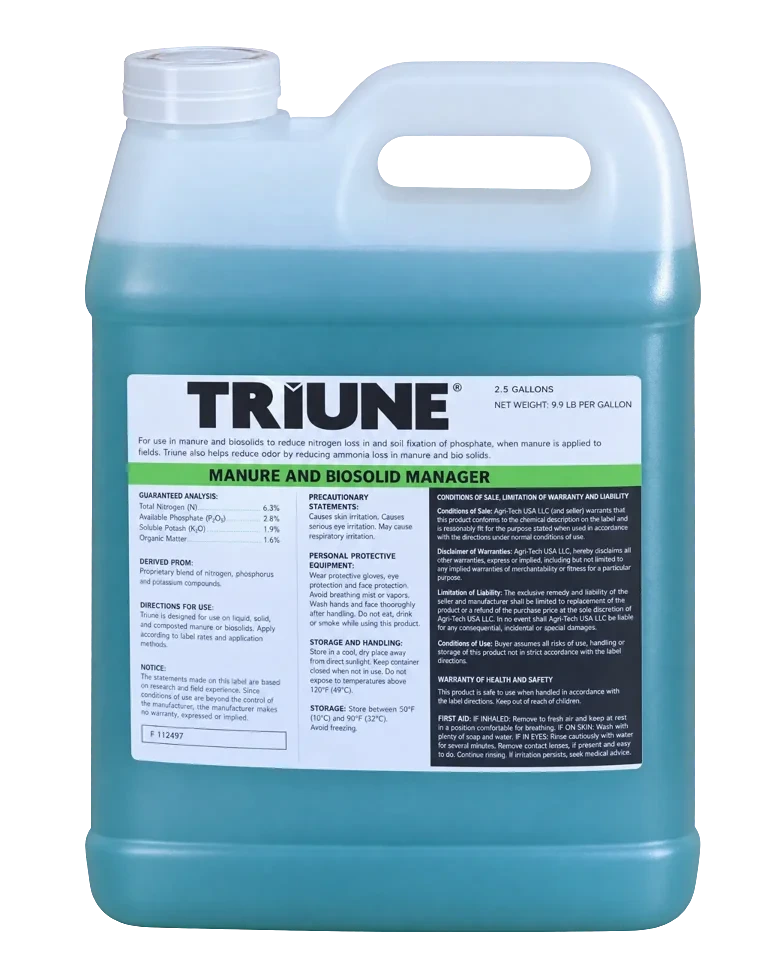

The fertilizer you
already own.
Most of it is escaping.
Over half the nitrogen in a pit can leave as ammonia before the load ever reaches the field, and the phosphorus that does get there locks up the same way commercial P does. TRIUNE is charge control chemistry that works at the surfaces where the losses actually happen — stopping the crystals that cement crust and sludge, and holding nitrogen in the ammonium form at the one interface it can escape from. A few parts per million is enough.
Your cheapest fertilizer
is leaking.
Livestock operations sit on their cheapest fertilizer and lose most of the value of it three separate ways — in the air, in the bottom of the pit, and in the soil once it is spread.
Over half the nitrogen
Ammonium converts to ammonia gas and leaves the pit and the field. It is the single largest loss, and it takes the odor and the neighbor complaints with it.
Solids settle, crust forms
Nutrients drop to the bottom, a crust sets on top, and what you pump out thin at the start comes out thick at the end — so no two loads carry the same analysis.
Phosphate locks up
Phosphate from manure meets the same calcium, iron and aluminum as phosphate from a bag, and locks up the same way — while soil test P still climbs.
Every pound of N, P and K that stays in the manure and reaches the field is fertilizer you never have to buy. That is the whole proposition — it is not a new input, it is a recovery of one you already own.
It works at the surfaces,
not in the bulk.
TRIUNE is high-charge anionic chemistry that works at threshold concentrations — a few parts per million are enough, because it does not have to treat the volume of the pit. It acts where the reactions actually happen: on mineral surfaces, and at the one interface where nitrogen can leave.
The crystals never cement
Crust and sludge are set by struvite and calcium-phosphate crystals growing together. TRIUNE stops them forming — so the solids, and the N, P and K held in them, stay suspended and pumpable instead of going to the bottom.
The only way out is closed
Ammonia can only escape at the surface. TRIUNE forms a charged layer there that holds nitrogen in the ammonium form as it reaches the interface, instead of letting it convert and go off as gas.
The conditions themselves go
Removing the stratified, high-pH surface layer and the anaerobic sludge cone beneath it takes away what generates ammonia and hydrogen sulfide in the first place. You are not masking the gas, you are removing the factory.
This is why a few ounces treat a whole pit. A product that had to bind every ion in half a million gallons would be sold by the metric ton. A threshold surface chemistry does not — it only has to be present where the crystals nucleate and where the interface sits. The same reason a few ounces of NutriCharge protect an acre of phosphate: blocking a crystal as it forms costs a fraction of what binding a nutrient one-for-one would.
Starts on contact
No colonization period and no warm-up. Ammonia and odor change inside 72 hours; crust and solids take a minimum of eight weeks to fully turn.
Holds through the season
One dose disperses through the whole pit and keeps working as manure builds on top of it. No re-dosing schedule to run.
Nothing alive to keep alive
Biologicals rely on live cultures that cold, pH swings and toxicity kill, and they work by digesting solids. TRIUNE performs the same in any pit, any season, out of every jug.
One platform, applied to manure. Stopping a calcium-phosphate crystal in a pit and stopping one in the soil are the same chemistry doing the same job in two places. TRIUNE is the manure expression of the charge control platform behind NutriCharge and TriPhase — which is why the phosphorus numbers move as hard as the nitrogen ones: +48% P per acre on hog, +40% on dairy, +37% on a Wisconsin lagoon.
36 ppm ammonia,
down to 6.
In a controlled hog-barn trial, Draeger readings averaged 36 ppm in the control barn and just 6 ppm in the TRIUNE barn — an 83% reduction in measured ammonia. Odor is lost nitrogen you can smell.
Less measured ammonia
Controlled hog-barn trial, Draeger readings: 36 ppm control vs 6 ppm treated.
Independently validated
Bavarian lab study of TRIUNE-treated pig slurry: 207 ppm untreated vs 132 ppm treated NH3, with methane, CO2 and H2S falling alongside.
Feed conversion
Nursery pig trial: FCR improved and average daily gain rose +0.07 lb/day in treated pens — cleaner air, better performance.
To first change
Ammonia and odor shift within three days. Solids and crust need a minimum of eight weeks to show.
The EU targets agricultural ammonia under Directive 2284/2016. The Bavarian measurement was made with lab instrumentation on TRIUNE-treated slurry and documented a steady, lasting NH3 decline — which positions TRIUNE as an emissions tool as rules tighten.
Solids in suspension.
Crust gone.
Untreated solids settle, so a pit pumps thin at the start and thick at the end and no two loads carry the same analysis. TRIUNE holds solids at a steady ~10% from first load to last.
Untreated drift
Solids through pumping: thin at the beginning, thick at the end — uneven nutrients across the field.
Treated, start to finish
10.6% beginning, 9.7% middle, 10.1% end. A consistent analysis and uniform distribution, no streaking.
Less agitation time
Haulers typically agitate in about a third less time, and the load pumps and spreads clean.
Cleared a sediment cone
Agrostar Kft, Hungary: a sludge cone the mixers could not reach was dispersed and the surface crust cleared. The operation moved to farm-wide treatment the next season.
Protect the nutrients.
Grow more.
The odor and solids benefits pay off in the barn. The real money is in the field — more N, P and K reaching the crop, proven in the manure analysis and again at harvest.
Hog pit · 5-sample average
+31% N, +48% P, +29% K. Treated and adjacent control barns sampled at hauling and sent to an independent lab: 79 more lb N, 53 more lb P and 47 more lb K per acre.
Wisconsin dairy · 4M gal lagoon
+45% N, +37% P, +13% K. Treated June, sampled at November hauling: total nutrient value $178 → $225 per acre, with a higher dry matter percentage too.
Dairy slatted barn
+40% phosphorus — the standout, and the nutrient hardest to replace. Total nutrient value $269.59 → $302.65 per acre.
Independent trials, one pattern
Hog, dairy and lagoon, different species and geographies: more N, more P, more value, every time.
Nutrient analyzes run by independent laboratories on treated and untreated manure from the same operation, sampled at hauling. Values calculated at the fertilizer prices of the sampling year — confirm current values against your own program.
It shows up
at harvest.
Protected nutrients do not just show up in a lab report. Across replicated plots, a USDA-run trial and 557 commercial acres, the same manure treated with TRIUNE has out-yielded itself untreated — and out-yielded synthetic urea.
Silage corn
Same manure source, same field: 10.53 vs 7.15 tons per acre dry weight — a 47% increase. Dairy forage research trial, harvested November 2019.
Grain corn · Spring Green, WI
Manure at 8,000 gal/ac with TRIUNE at 18 oz/ac over a 19-19-19 starter and 150 lb ESN. The only variable was TRIUNE. On $4–5 corn that is $70–90 an acre.
USDA replicated · Fond du Lac, WI
241.7 vs 230.0 bu/ac across three reps each, off the same manure. The response repeats in independent, replicated hands.
Iowa, heavy manure ground
Three replicated Growmark sites, TRIUNE added to the honey wagon: +50, +19 and +5 bu/ac. Every plot gained.
Treated manure beat the bag
Grain corn: urea 174, untreated manure 183, TRIUNE manure 198 bu/ac. Silage: 14.5, 15.8, 18.5 t/ac. Treated manure out-yielded synthetic urea on both.
Chemistry beat the biological
An independent regulatory trial applied the same slurry four ways. Control 73, untreated 79, biological additive 82, TRIUNE 84 bu/ac — because it holds nitrogen chemically rather than relying on microbes.
+85.8% total yield per plant
A government food-safety authority applied the same slurry with and without TRIUNE: +85.8% total yield, +50% more fruit per plant, +22% taller at harvest, at P<1% significance.
Sources: dairy forage research trial 2019 · Spring Green WI 2019 · USDA Fond du Lac WI, manure applied November 2019, harvested 2020 · Growmark replicated plots, Iowa · 557-acre commercial trial · NÉBIH official trial T-PFBL-04-2020, Hungary. Full data available on request.
How much you need,
and what it treats.
Hog manure 1 qt per 7,000 gal · dairy manure 1 qt per 14,000 gal · manure applied in the field 18–24 oz per acre. Confirm rates with your AgroTech representative for your system and analysis.
Lagoon, pit or litter.
| Application | Rate |
|---|---|
| Hog manure | 1 quart per 7,000 gallons treated |
| Dairy manure | 1 quart per 14,000 gallons treated |
| Applied to manure in the field | 18–24 oz per acre of manure applied — inline on the way out, no pit access needed |
| Poultry litter | Treated before or at spreading — contact us for your litter analysis |
| Frequency | 1–2 applications per year |
| Equipment | No change — treated in the pit, lagoon or tank you already use |
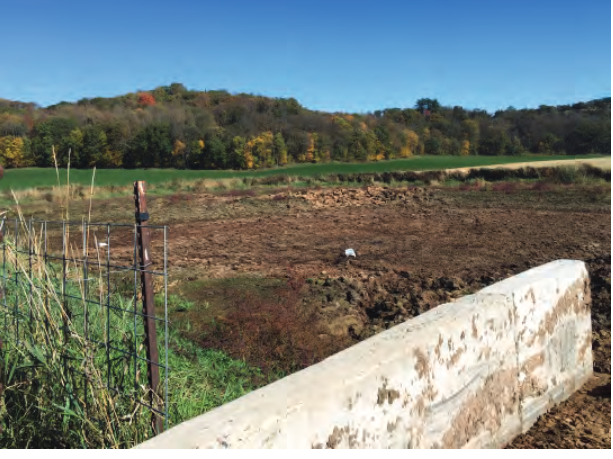
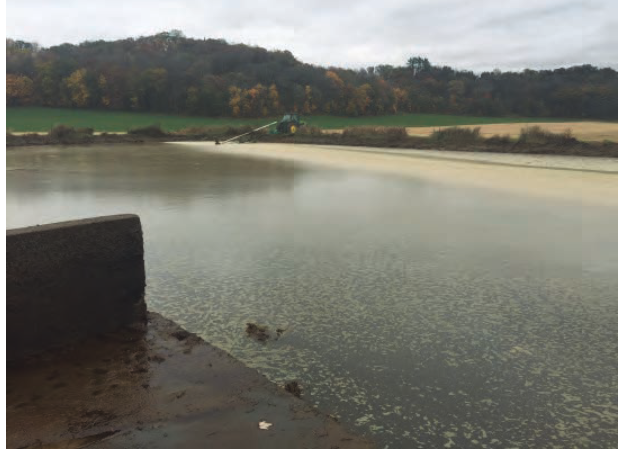
A crust set hard enough to look like bare ground, and the same lagoon with it broken and the solids back in suspension. Block the crystals that cement it and there is nothing to hold it together — which is what makes the load pump and spread evenly.
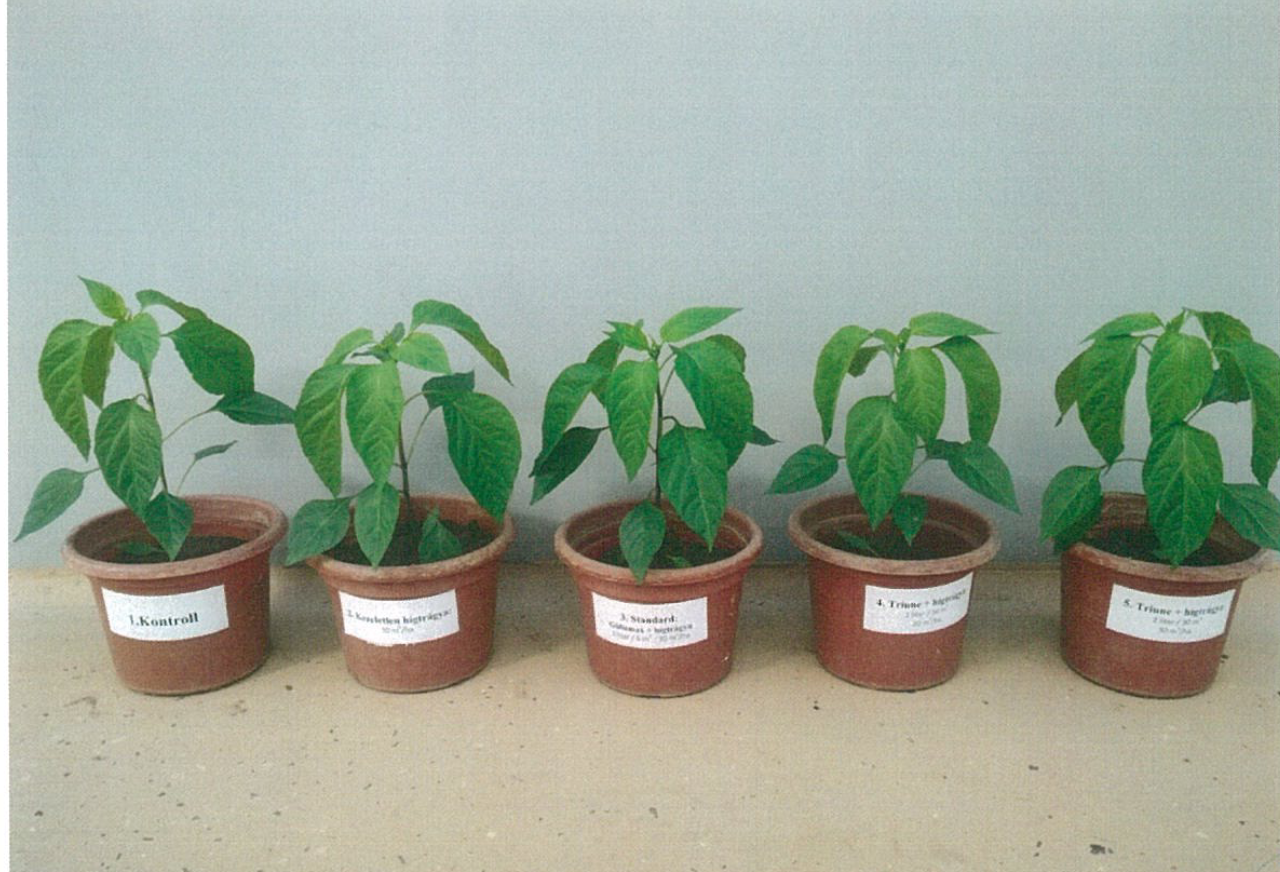
NÉBIH accredited regulatory trial T-PFBL-04-2020, Hungary. The same slurry applied with and without TRIUNE: +85.8% total yield per plant, +50% more fruit, +22% taller at harvest, at P<1% significance.
Straight answers.
How is this different from the microbial products I already use?
Will this help my nutrient management plan?
Can I use it with commercial fertilizer too?
Does it cut odor and ammonia, or just phosphorus?
How is it different from a biological additive?
How often do I apply it?
More P out of the manure
you already have.
Talk to an agronomist about your lagoon, pit or litter program — we will size it to your system.