5 Phosphorus Myths That Are Costing You Bushels

A myth-based approach to phosphorus management costs growers millions of dollars annually in lost yield and wasted inputs.
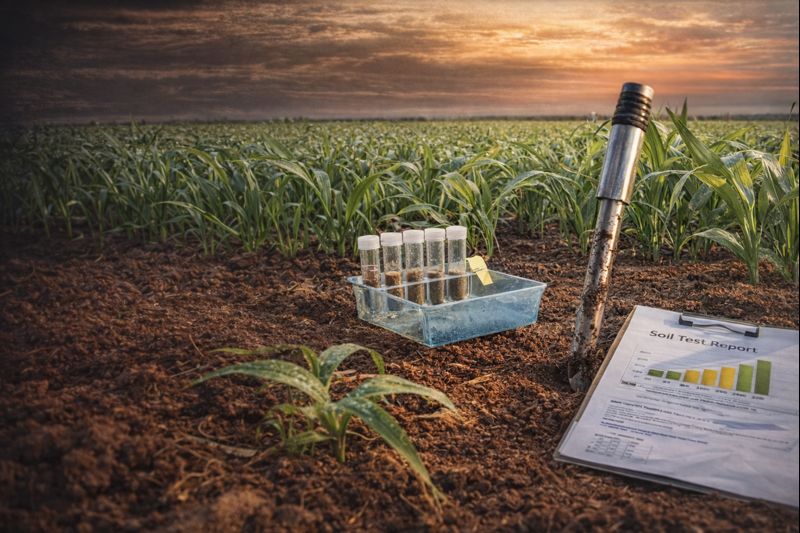
Myth #1: "My soil tests high for P, so my crop has plenty."
Reality:
A soil test measures total extractable phosphorus using strong acid chemistry. It does not measure plant-available phosphorus at 50°F, in a soil with only 2 inches of root depth, competing against calcium, iron, and aluminum fixation.
Iowa State University research confirms that yield responses to banded starter phosphorus appear even at 40+ ppm Bray-1. A high soil test reflects long-term phosphorus accumulation. Early-season plant availability is a different parameter entirely.
Myth #2: "If my crop looks green, it's getting enough phosphorus."
Reality:
Visual phosphorus deficiency—the purple discoloration and stunting—arrives too late to prevent yield loss. The University of Illinois documented that measurable yield losses occur with zero visible symptoms.
Kernel row number is determined at V5-V6. Ear size is locked in by V8. These developmental milestones happen silently. By the time purple leaves appear in late June, the yield loss is already encoded into the plant architecture.
Phosphorus starvation is invisible when it matters most.
Myth #3: "I can fix a phosphorus shortage later in the season."
Reality:
Phosphorus is immobile in soil. Once applied, it does not migrate through the profile to reach roots. Side-dressing phosphorus in May or June is ineffective because by then the root system is too developed to efficiently explore new phosphorus in non-contact zones.
Foliar phosphorus applications deliver 0.5–1.0 lb of actual P/ac. A crop requires 15–50 lbs at V0-V6. The math does not work. Root architecture and yield-determining structures are built in the first 30 days. That window closes.
Myth #4: "Applying more phosphorus solves the availability problem."
Reality:
Doubling the MAP or DAP rate does not double early uptake. In many soils, 70–90% of broadcast phosphorus is bound (fixed) by calcium, iron, and aluminum within 72 hours of application.
More rate simply means more tie-up. It is inefficient and economically unjustifiable. Early-season phosphorus availability is a chemistry problem, not a quantity problem. Placement and product selection are the levers. Rate is secondary.
Myth #5: "Phosphorus technology products are just expensive snake oil."
Reality:
Legitimate phosphorus technology products are backed by independent university research and patent protection. AC³ Technology, for example, has 10+ years of peer-reviewed trial data from multiple land-grant universities demonstrating consistent improvements in early phosphorus uptake and yield response.
If a product cannot provide independent, third-party trial results, walk away. NutriCharge can. Any phosphorus technology worth deploying must demonstrate real-world performance against conventional sources under controlled, replicated conditions.
Skepticism is justified. Validation is not.
Bottom Line
Phosphorus management is not about guessing what the crop needs. It is about understanding the science of what the crop needs, when, and how to deliver it. High soil tests do not guarantee early-season availability. Banding matters. Technology matters. Timing matters.
For a phosphorus consultation tailored to your operation, visit AGROTECHUSA.com to connect with one of our agronomists.