The Complete Guide to Early-Season Phosphorus Management

Why Phosphorus Timing Beats Phosphorus Rate
The most persistent misconception in crop nutrition is that phosphorus rate determines early-season availability. Research demonstrates the opposite: timing and placement dramatically outpace raw application rate.
A grower applying 80 lbs P₂O₅ broadcast into cold soil achieves significantly lower early uptake than a neighbor banding 40 lbs P₂O₅ in 2x2 placement at planting. Why? Phosphorus diffusion drops approximately 50% below 60°F soil temperature. The nutrient physically cannot migrate to the roots at the speed required during early growth.
On high-testing phosphorus soils—those exceeding 30 ppm Bray-1—this effect intensifies. The additional phosphorus binds to calcium, iron, and aluminum before roots access it. Placement efficiency becomes the limiting factor, not total rate.
The outcome: a carefully positioned 40 lb P₂O₅ band outperforms 80 lbs broadcast across the field. The crop gets what it needs when it needs it.
What Happens in the First 30 Days After Emergence
The window between V0 and V6 determines the fate of the crop in ways many growers overlook. At emergence, the root system explores less than 5% of the soil volume it will eventually access at physiological maturity. Phosphorus is the primary driver of ATP production, which fuels cell division during this explosive growth phase.
Iowa State University research established a critical finding: kernel row number is set between V5 and V6—just 2 to 3 weeks after emergence. This developmental stage does not repeat. The ears are predetermined. Later fertilizer applications cannot recover lost kernel rows.
If a crop is phosphorus-deficient during this window, the deficit is permanent. Yield loss is already encoded into plant architecture before the crop shows visible symptoms.
Why "High Soil Test P" Doesn't Mean Your Crop Has Enough
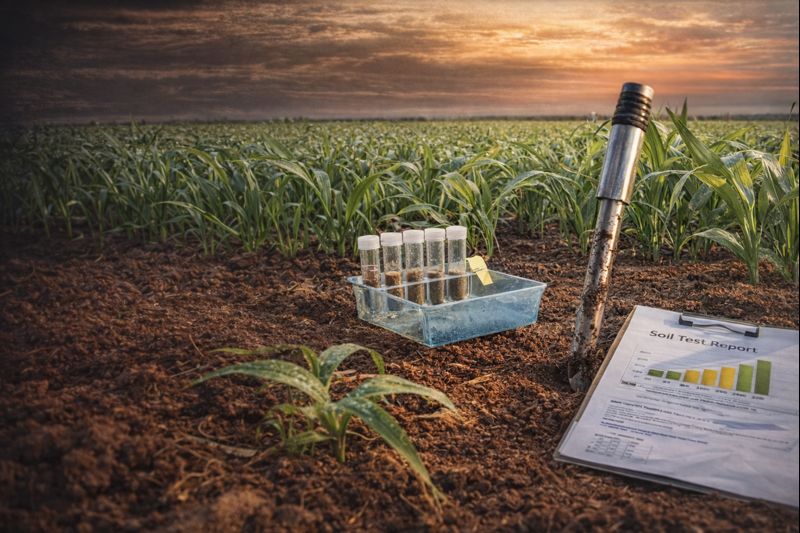
Bray-1 and Mehlich-3 soil phosphorus extractions use strong acid chemistry that does not reflect plant availability in cool, early-season soil. A 40 ppm Bray-1 result in March is not the same as a 40 ppm environment at 50°F with a shallow root system.
No-till systems, high-pH soils, and heavy residue all tighten the availability gap further. Phosphorus binds more readily, diffuses more slowly, and concentrates in upper soil layers where spring roots struggle to reach.
Dr. Antonio Mallarino at Iowa State University has repeatedly documented that even fields testing 30+ ppm Bray-1 show measurable yield response to 10–20 lbs of banded P₂O₅ applied at planting. The phosphorus is there; it is simply not accessible to the crop during the critical first 30 days.
The Real Cost of Early Phosphorus Deficiency
"Hidden hunger" is the term for yield loss that occurs without visible phosphorus deficiency. University trials commonly document that 5–15 bu/ac losses are common in phosphorus-limited early seasons, with the crop showing zero purple coloration or stunting.
Why is recovery so expensive? Phosphorus is immobile in the plant. Once the kernel row count is set at V6, it cannot be increased. Side-dressing phosphorus in May or June does nothing for the ears that are already sized. Foliar phosphorus applications deliver only 0.5–1.0 lb of actual P/ac—a fraction of what the crop needed 6 weeks earlier.
What You Can Do About It
Start with placement. A in-furrow or 2x2 planter package (2 inches to the side, 2 inches below the seed) positions phosphorus in the zone where emerging roots naturally forage. This is non-negotiable.
Next, evaluate phosphorus availability products. Conventional phosphorus contains excellent phosphorus, but the raw chemical form is only part of the solution. Products that enhance phosphorus availability through can improve early uptake dramatically compared to untreated sources.
NutriCharge with AC³ Technology represents the latest advance in this category. AC³ (Advanced Charge Control Chemistry) is designed to enhance phosphorus availability and root access during the critical V0-V6 window.
Integration with an overall fertility program—maintaining adequate sulfur, zinc, and other micronutrients—further amplifies phosphorus efficiency. These nutrients support the enzymatic pathways that enable phosphorus utilization.
Visit AGROTECHUSA.COM to connect with our agronomists and create a strategy tailored to your soil, conditions, and yield expectations.