
One chemistry.
Dry or liquid.
NutriCharge protects phosphate from the calcium, iron and aluminum that lock it up — impregnated on dry blends at the plant, or mixed into the liquid you already run. Same chemistry, same result, whichever way your phosphorus goes out.
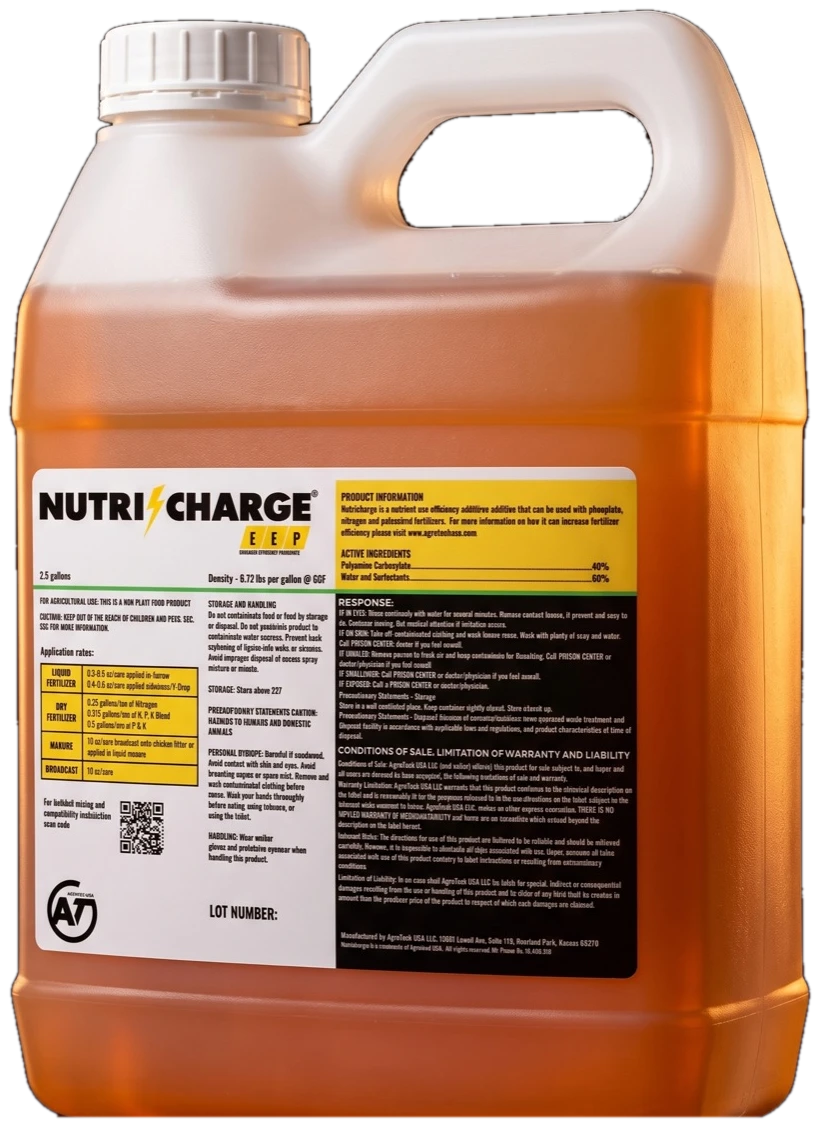
Two ways in.
One chemistry.
Impregnated on the blend
Applied at the blend plant on the impregnation equipment already in the yard — 0.5 gal per ton of MAP, DAP or a finished blend. No new pass for the grower, no capex for the retailer, and every granule goes out protected.
Mixed into the jug
Goes into 10-34-0, 6-24-6 or whatever starter is already built — in-furrow, 2×2, sidedress, Y-drop or fertigation. No rate change, no tank redesign.
It works on the cation,
not the fertilizer.
Right where the P dissolves
On a dry granule it is already on the surface as the prill breaks down. In a liquid it is already in solution. Either way it is there the moment phosphate enters the soil.
Where fixation is fastest
Concentrated phosphate — in a band or dissolving off a granule — reacts fastest of all with the Ca, Fe and Al around it. That is the moment it has to be protected.
A little protects a lot
Because it blocks crystal formation instead of binding cations one-for-one, half a gallon treats a ton — and ounces treat an acre of liquid. No rate penalty either way.
It also works on the phosphorus you already own. Your soil releases orthophosphate all season — the same form your fertilizer supplies, from a far bigger pool. NutriCharge protects that too, not just the pounds you applied this spring.
What your phosphorus
actually delivers.
Illustrative at your inputs. Dry treated at 0.5 gal NutriCharge per ton. Liquid analyses assumed at 11.65 lb/gal for 10-34-0, 11.0 for 6-24-6, 11.7 for 11-37-0. Availability multiplier grounded in BYU-Idaho replicated soluble-P studies.
Positive in all 24
replicated starter trials.
Average corn response
Across 24 replicated in-furrow and 2×2 starter comparisons — range +1.6 to +32.0 bu/ac, positive in every single one.
Soluble P at the 50 lb rate
BYU-Idaho, 11-37-0 liquid: 0.7 → 2.3 lb/ac soluble P. At 200 lb, 5.3 → 12.0 lb/ac.
Six years of NCSU corn
Aggregate response over the same untreated rate across five replicated trials — averaging +14.2 bu/ac with no change to the program.
At 30–70% less starter
Aggregate over the full untreated rate across four NCSU years — cutting starter and still beating it.
| Placement | What it does there |
|---|---|
| In-furrow | Protects starter P from fixation right where the young root can reach it, in cold soil when biology is switched off. |
| 2×2 / 2×0 | Same protection on a banded placement, with no change to rate, pass or equipment. |
| Sidedress & Y-drop | Rides the nitrogen pass at 0.25% v/v — keeping P available through peak demand, when most uptake happens. |
| Fertigation & drip | Injected with the run. Repeatedly wetted zones concentrate fixation; this is where protection pays hardest. |
| Dry coating | Impregnated on MAP, DAP or a finished blend at 0.5 gal per ton at the plant — every granule goes out protected, no new pass. |
Straight answers.
Is this a biological?
What is it compatible with?
Do I need new equipment or an extra pass?
Does it replace my phosphorus?
How much can I reduce my rate?
How long does it last?
Put it on the fertilizer
you already buy.
Talk to an agronomist about rate, placement and compatibility for your program — or find your nearest dealer.