
Unlock the phosphorus
you already own.
Your ground already holds far more phosphorus than any starter delivers — most of it locked in organic and mineral forms. P-Drive now carries TriPhase: enzymes free the phosphorus held in organic matter, TriPhase frees what is locked onto soil minerals, and NutriCharge keeps all of it available, so the crop draws on every pool without hauling more fertilizer.
Your starter isn't the problem.
There is simply far more phosphorus in the ground than any starter can supply. Per acre, on a 30 ppm Mehlich‑3 soil test:
The math: 1 ppm Mehlich-3 P ≈ 2 lb P/ac in the top 15 cm, so a 30 ppm test is roughly 60 lb P/ac already present. A 2.5 gal/ac 6-24-6 starter supplies ~2.8 lb P/ac. A 200 bu corn crop removes about 33 lb P/ac (75 lb P₂O₅), so the starter is roughly 9% of removal — compare like with like, elemental P against elemental P. Values are illustrative and depend on your soil test.
The challenge is not how much phosphorus is in your soil. It is how much of it the plant can actually reach.
Release · unlock · protect.
Phosphorus is locked in two places: organic matter and soil minerals. P-Drive goes after both, then holds what it frees. Three jobs, one product, the complete phosphorus solution.
Frees the phosphorus held in organic matter.
A mannanase and phosphatase enzyme system mineralizes bound organic phosphorus into plant-available orthophosphate — early, when roots are small and demand is high.
TriPhase frees what soil minerals hold.
Years of phosphorus have crystallized onto calcium, iron and aluminum — the mineral bank a soil test never sees. TriPhase charge-release chemistry dissolves that bound phosphate back into the soil solution.
NutriCharge keeps all of it available.
Freed phosphorus wants to lock straight back up. NutriCharge holds what the enzymes and TriPhase release, plus the starter you apply, in the soil solution where roots can reach it — across soil types and pH.
How much phosphorus is actually down there?
Your soil test reports what is extractable today. It says nothing about the organic pool, which is usually the larger one. This works that pool out from your organic matter, and shows how much of it is already mineralizing each year without anything applied.
Your soil test
Your crop
Assumptions change them if you disagree
The uplift field is yours, not ours. We are not going to hand you a number for how much more an enzyme releases — that depends on your soil, your season and your organic matter, and we would rather you tested it than took our word. Set it to whatever you think is plausible and the panel will show what it would be worth.
What is in your top 6″
Against what the crop needs
How this is worked out
Soil mass. Acre-furrow-slice at your depth and bulk density. At 6″ and 1.33 g/cm³ that is the familiar 2,000,000 lb/ac, which is where “1 ppm ≈ 2 lb/ac” comes from.
Organic P. Organic matter ÷ 1.72 gives organic carbon (Van Bemmelen). Organic carbon divided by the C:P ratio gives organic phosphorus. Cultivated topsoils commonly run 100:1 to 200:1; we default to 110:1. This is an estimate from organic matter, not a measurement — a total or organic P test is the real answer.
Mineralization. Net annual mineralization of soil organic P is commonly put at 2–5% of the organic pool per year. We default to 3%. This is what is already happening in your field with nothing applied.
Crop removal. Grain removal coefficients of 0.375 lb P₂O₅/bu for corn, 0.80 for soybean and 0.50 for wheat, converted to elemental P by ×0.4364. Removal and soil P are both shown as elemental P so they can be compared honestly — mixing lb P with lb P₂O₅ overstates the gap by well over double.
What this does not do. It does not predict yield, and it does not tell you how much extra phosphorus an enzyme will release on your farm. It sizes the pool and the flux so you can judge whether the opportunity is worth testing.
Three ounces. One pass.
Whole-acre rate
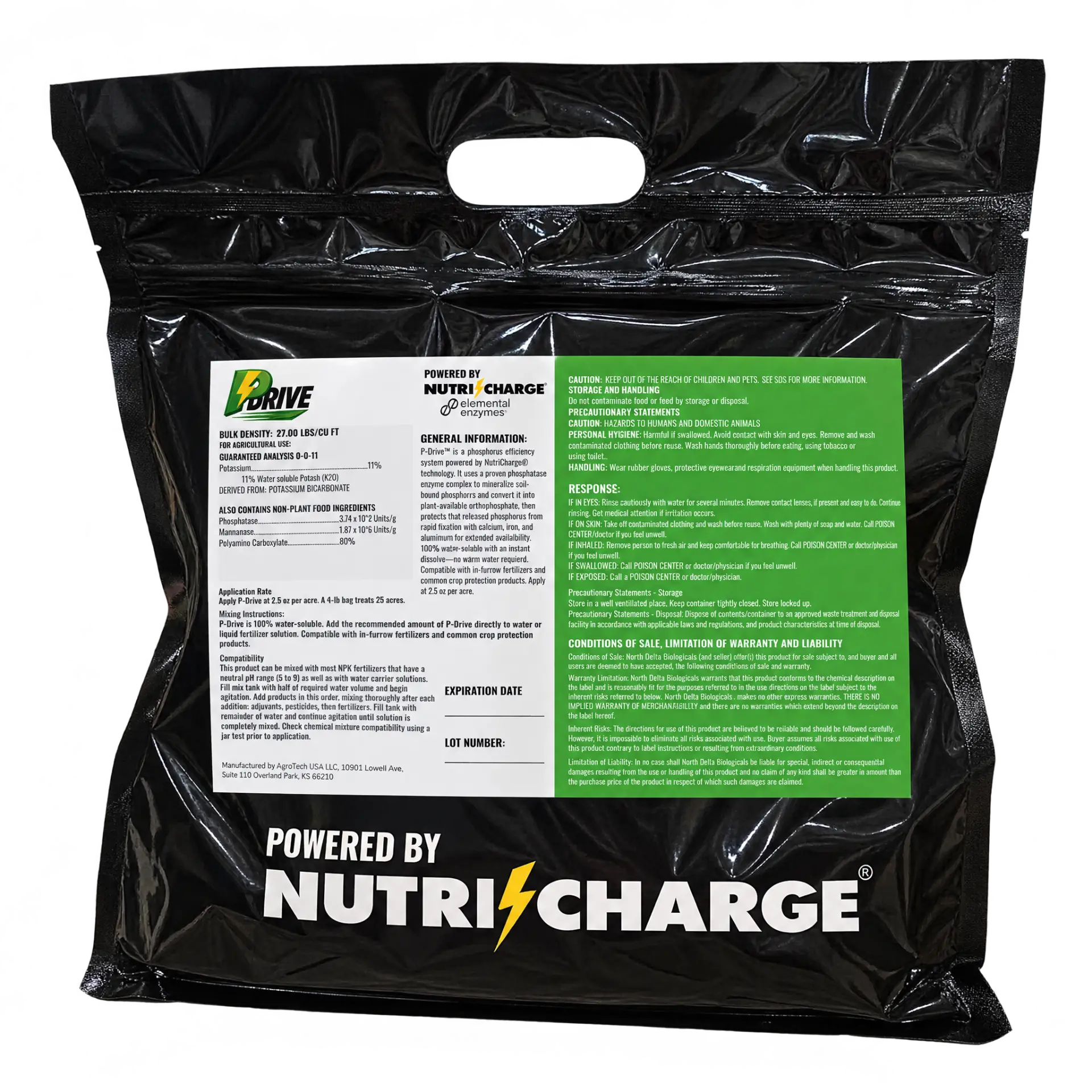
Same rate and timing as before, with TriPhase built in. 100% instant dissolve — no warm water, no grit, no sludge. Less weight to handle and cleaner tanks.
Release, unlock, protect
An enzyme system frees soil phosphorus; NutriCharge keeps it soluble instead of letting calcium, aluminum and iron take it back.
Fits any program
Runs in-furrow with what you already have. Compatible with starter fertilizers and common crop protection products. No new pass.
Straight answers.
Is this a biological?
Does it replace my starter?
How is it different from NutriCharge on its own?
How is it different from TriPhase on its own?
What is the rate, and how is it handled?
Will it tank-mix with my crop protection?
Does it work on high-pH ground?
Put the phosphorus in your soil to work.
Tell us your soil test and what you already run in-furrow, and we will tell you whether P-Drive is worth your time.