
Protect the phosphorus
already at the seed.
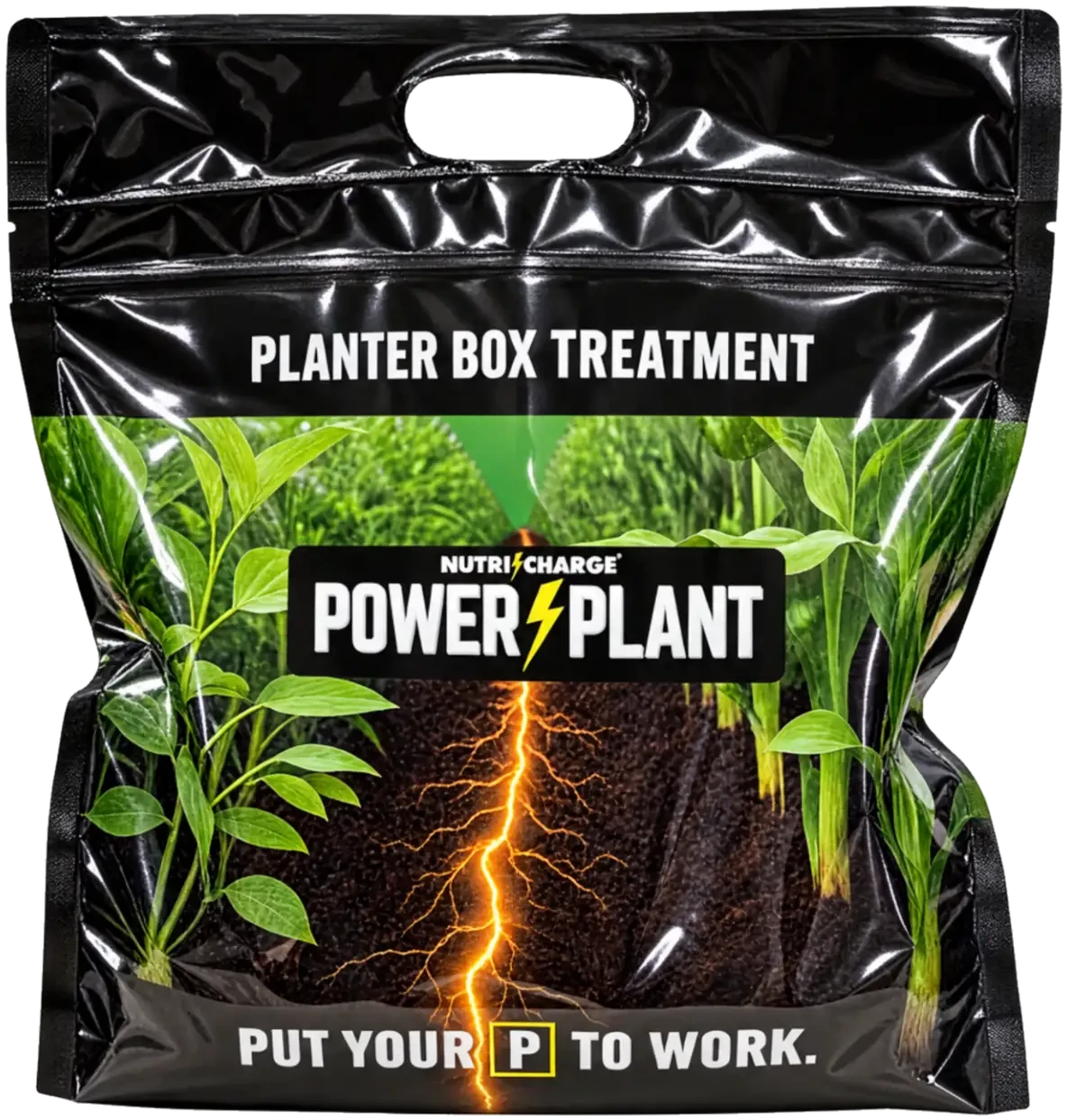
Phosphorus matters most in the first three weeks — cold soil, no root system, biology switched off. PowerPlant goes in the planter box in place of your talc or graphite — alongside your starter, or instead of one.
Cold soil is where phosphorus is
won or lost.
A seed has to build a root before it can find anything. That takes ATP — and ATP is built from phosphate.
Phosphorus doesn't travel.
N and K move to the root with water. Phosphorus barely moves at all — it has to diffuse the last fraction of an inch, and diffusion is slow when the ground is cold.
A two-week-old seedling only gets what is already within millimetres of it.
Relative mobility in the soil solution. P is the one that has to be waiting where the root arrives.
Microbes are asleep at planting.
A biological needs warm soil and time to colonize before it releases anything. It contributes nothing in the window that sets the stand — and that window is the whole point.
By the time soil biology wakes up, the stand is already set.
There is soluble P right there.
A small, continuous trickle in the soil solution — and it's what the seedling lives on. PowerPlant works on exactly that P, from the moment moisture hits the seed.
It supplies no phosphorus of its own. It keeps what's already there from locking up — which is why a few ounces is enough.
ppm dissolved P · Webberville soil columns, June extractions 2024. NutriCharge chemistry alone delivered more P in solution over the first 28 days than 5 GPA of starter alone.
It beat a liquid starter.
Two years running.
Moultrie, two seasons: +4.5 bu against a 3 gal/ac starter, then +16 bu when they raised it to 5 gal/ac. More liquid did not close the gap.
Two-year average
vs a liquid in-furrow starter program.
Corn, net of product
PTI replicated: 251.5 → 255.0 bu vs talc/graphite.
Soybeans, net of product
PTI: 75.6 → 78.4 bu. The box is the only way onto a bean seed.
Break-even on corn
That is all the response has to clear.
PTI trials run against an 80/20 talc/graphite control on ground testing 42 lb/ac phosphorus.


Out of the ground faster.
At the same point in the emergence window, 86% of the treated stand was up — against 58% untreated.
Agri-Tec replicated corn trial, Whitewater, WI · percentage of final stand emerged, measured mid-window.
What one bag
actually covers.
Label rate is a band: 2–3 oz per unit on corn and 1.5–2 oz per unit on soybeans. Coverage above is from a 5 lb bag at one unit planting ~2.5 acres of corn and ~1 acre of soybeans, and bags are ordered on the heavier end so you are not short. Your seeding rate will move both figures — confirm with your agronomist.
Lubricant plus chemistry.
| Specification | Detail |
|---|---|
| Corn rate | 2–3 oz per unit of seed |
| Soybean rate | 1.5–2 oz per unit of seed |
| Pack size | 5 lb bag — approximately 65–100 acres of corn or 40–50 acres of soybeans, depending where in the label band you run |
| Applied | In place of talc or graphite — same method, same equipment, one fewer product to buy |
| Guaranteed analysis | 0-0-0 · 2% sulfur · 2% manganese · 5% zinc |
| Also contains | Polyamino carboxylate 35% · dry micro-algae 20% |
| Storage | Dry place, as with talc or graphite. Agitate before use if settled in shipping |
Straight answers.
Does it replace talc or graphite?
Will it plug my meters?
Is the micronutrient rate meaningful at 3 oz?
Can I use it if I already run a starter?
Does it work on soybeans?
How is this different from a humic or a chelate?
Is it a biological?
The pass you already make.
Now it does something.
Ask your dealer about PowerPlant, or talk to an agronomist about fitting it to your planter and your program.